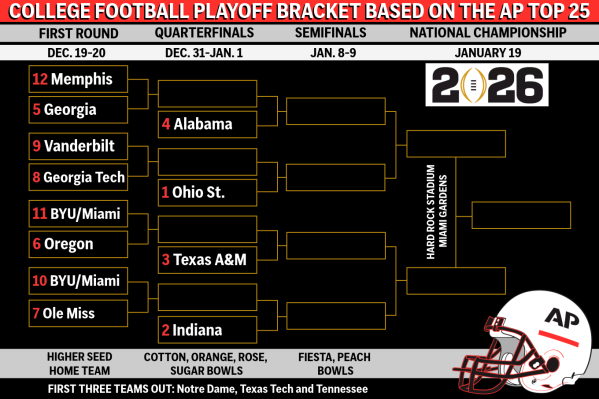
Every Sunday of the season, millions of fans eagerly await the new AP Top 25 rankings for college football . It’s the oldest and most cited ranking in the sport, and moving up or down just a few spots can change the narrative of an entire season. But who votes, how are the points tallied, and what’s their real weight? We’ll explain it all step by step.
What is the AP Top 25 ranking?
The AP Top 25 is a weekly poll by the Associated Press that ranks the 25 best teams in the FBS, the top division of college football in the United States. It originated in 1936 as the brainchild of sportswriter Alan J. Gould. It began as a Top 10 ranking and later became a Top 20 ranking; since 1989, it has maintained its current 25-team format.
Who votes in the AP Top 25?
Approximately 60 journalists and commentators who cover college football for AP-affiliated media outlets vote. Agency employees do not vote, but they do select the voters, aiming to ensure that each state with an FBS program has at least one representative.
The ballots are public, so anyone can see how each journalist voted. One example is our article on the AP Top 25 Week 12 ballot revealed by a voter , with the reasoning behind each position.
How are the points calculated?
- Each voter ranks their 25 best teams.
- Position 1 receives 25 points, position 2 receives 24, and so on down to position 25, which receives 1 point.
- The points from all ballots are added together.
- The 25 teams with the most points form the official ranking; the rest appear as “others that receive votes”.
Alongside each team, the number of votes for first place is also published , key to measuring how solid the number 1’s dominance is.
When is the ranking published?
The first poll is the preseason poll, in mid-August. After that, it’s released every Sunday during the regular season, and there’s a final ranking after the postseason.
What factors influence the vote?
The AP is asking its voters to avoid regional biases and to consider head-to-head matchups. In practice, the following also have an influence:
- Victories against ranked opponents. Beating a Top 25 team is worth more than accumulating wins against weaker opponents.
- How defeats come about. Losing by a narrow margin against an elite opponent doesn’t punish as severely as a surprising defeat.
- Injuries to key players. A significant loss changes the perception of a team, as when Indiana lost Joe Brunner to a torn ACL .
- Strength of the schedule. Teams in demanding conferences usually have more margin for error.
AP Top 25 vs. ranking del College Football Playoff
This is the most common misconception: the AP Top 25 doesn’t determine who makes the College Football Playoff. That’s done by an independent selection committee, which publishes its own rankings in the second half of the season. Even so, the AP poll dominates the media conversation and, for decades, has been used to determine the national champion. There’s also the Coaches Poll , voted on by coaches, which tends to largely align with the AP poll.
Frequently Asked Questions
How many voters does the AP Top 25 have? Around 60 journalists and specialized commentators.
How many points does first place give? 25 points; 25th place gives 1 point.
What day is the AP Top 25 published? On Sundays during the regular season.
Does the AP Top 25 choose the playoff teams? No. The College Football Playoff Committee does, using its own ranking system.
Conclusion
Understanding how the AP Top 25 ranking works allows you to read each week with fresh eyes: who wins votes for first place, which teams climb after a big win, and which ones pay dearly for an injury. Stay up-to-date with college football, the NFL, and the NBA in Sports , and if you’re interested in basketball, don’t miss our guide to the 2027 NBA trade deadline .
Fuente oficial: AP Top 25 college football poll – Associated Press.